
Building a sales funnel gives your business a clear process for turning strangers into leads and leads into paying customers. Instead of relying on random promotions, you guide potential buyers through a planned journey based on their needs, questions, and level of interest.
A well-designed funnel helps you attract the right audience, build trust, present a suitable offer, and encourage people to take action. It can also reveal where potential customers lose interest, allowing you to improve each stage over time.
In this guide, you will learn how to build a sales funnel from scratch, from identifying your ideal customer to measuring conversions and improving results.
What Is a Sales Funnel?
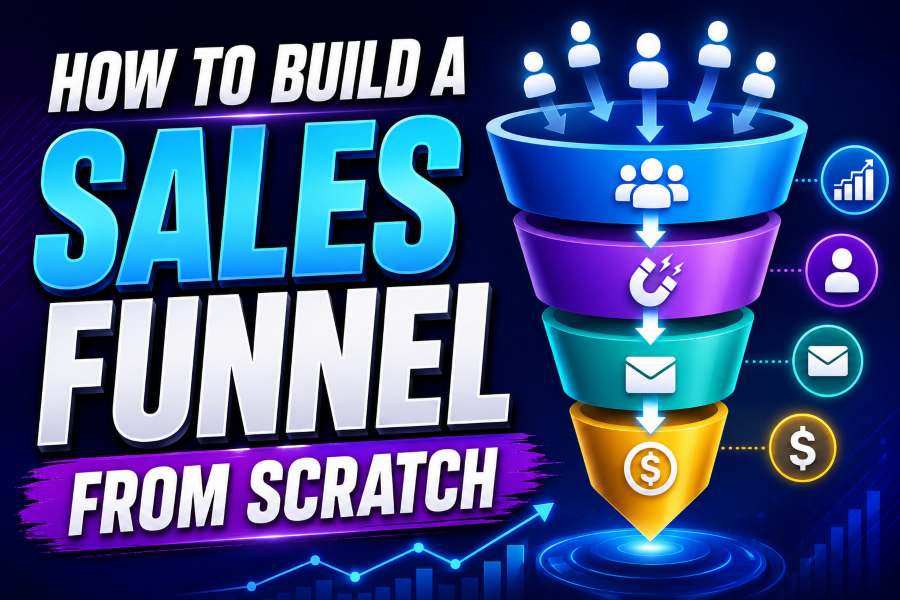
A sales funnel is the series of steps a potential customer follows before completing a purchase. It is called a funnel because many people may discover your business, but only a percentage of them will move through every stage and become customers.
For example, one thousand people may see your social media advertisement. Two hundred may visit your landing page, fifty may join your email list, and ten may purchase your product. The audience becomes smaller as people move closer to the final decision.
A basic sales funnel usually includes four stages:
- Awareness
- Interest
- Consideration
- Conversion
Some funnels also include retention and advocacy stages. These additional steps focus on encouraging repeat purchases, reviews, referrals, and long-term customer relationships.
Why Your Business Needs a Sales Funnel
A sales funnel gives your marketing activities a clear direction. Without one, you may attract website visitors but fail to guide them toward a meaningful action.
The funnel helps you match your message to the customer’s current position. A person discovering your brand for the first time usually needs educational information. A person comparing prices may need testimonials, product details, or a demonstration.
A sales funnel can help your business:
- Generate qualified leads
- Improve conversion rates
- Shorten the buying process
- Build trust with potential customers
- Track marketing performance
- Increase repeat sales
- Make advertising more profitable
It also prevents your sales and marketing teams from treating every lead in the same way. Each prospect receives content and offers that fit their level of interest.
Define Your Main Sales Funnel Goal
Before creating landing pages or email sequences, decide what you want the funnel to achieve. A funnel should have one main conversion goal so visitors know what action to take.
Your goal may be to sell a product, generate consultation requests, book appointments, collect email subscribers, encourage software trials, or promote an online course.
Choose a goal that can be measured. Instead of setting a general goal such as “get more customers,” use a specific target, such as generating fifty consultation bookings every month.
Your funnel goal will influence your content, traffic sources, lead magnet, email campaign, landing page, and offer. Every part of the funnel should support the same final action.
Identify Your Ideal Customer
A sales funnel works better when it is created for a clearly defined audience. Trying to reach everyone often leads to broad messaging that connects with no one.
Start by creating an ideal customer profile. Consider the person’s age, location, occupation, income range, interests, goals, challenges, buying habits, and preferred communication channels.
You should also identify the problem your audience wants to solve. People usually purchase products because they want a result, avoid a difficulty, save time, reduce costs, or improve an area of their lives.
Ask questions such as:
- What problem is the customer currently facing?
- What result do they want?
- What prevents them from reaching that result?
- What concerns may stop them from buying?
- Where do they search for information?
- What other products are they comparing?
Customer surveys, support conversations, online reviews, website analytics, and competitor research can provide useful information. The more accurately you define your audience, the easier it becomes to create relevant funnel content.
Map the Customer Journey
The next step is to map how a potential customer moves from discovering your business to making a purchase.
Each stage should answer a different type of question. At the awareness stage, the customer may ask what is causing their problem. During consideration, they may compare several solutions. Near the conversion stage, they may evaluate price, features, guarantees, and credibility.
A simple customer journey may look like this:
- The customer discovers a blog post through Google.
- They download a free checklist.
- They receive helpful emails.
- They visit a product or service page.
- They read testimonials and pricing information.
- They book a call or complete a purchase.
- They receive follow-up support and additional offers.
Mapping this journey helps you identify what content, pages, and messages are required at each step.
Create Awareness-Stage Content
The top of the funnel focuses on attracting people who may need your product but are not ready to buy yet.
At this stage, provide useful information related to your audience’s problems. Avoid making every piece of content a direct sales message. Your main goal is to earn attention and establish credibility.
Effective awareness content includes:
- SEO blog posts
- Social media posts
- Short educational videos
- Podcasts
- Infographics
- Guides
- Checklists
- Webinars
- Paid advertisements
For example, a digital marketing agency may publish an article about why website traffic is not converting. A fitness coach may create a video about common workout mistakes. A software company may publish a guide about managing remote projects.
Use keyword research to find questions your audience is actively searching for. Choose topics that connect naturally with your product or service.
Choose the Right Traffic Sources
Your funnel needs a steady source of targeted visitors. The best traffic channel depends on your audience, budget, industry, and offer.
Search engine optimization can generate long-term organic traffic, although it usually takes time to build rankings. Paid advertising can produce visitors quickly, but it requires careful targeting and budget control.
Common traffic sources include:
- Google Search
- YouTube
- TikTok
- Email marketing
- Referral partnerships
- Influencer campaigns
- Online communities
- Paid search advertisements
- Display advertising
You do not need to use every channel. Start with one or two platforms where your ideal customers are already active.
Track which traffic sources generate leads and customers rather than focusing only on clicks or impressions. A smaller channel with qualified visitors may produce better results than a larger channel with low buying intent.
Create a Valuable Lead Magnet
Most visitors will not purchase during their first interaction with your business. A lead magnet gives them a reason to share their email address or contact information.
A lead magnet is a free resource that solves a small but meaningful problem. It should be closely connected to the product or service you eventually want to sell.
Examples include:
- Downloadable checklist
- Free template
- Email course
- Industry report
- Calculator
- Product trial
- Discount code
- Webinar
- Case study
- Free consultation
- Quiz or assessment
The lead magnet should provide an immediate benefit. A generic newsletter invitation is often less attractive than a specific promise, such as “Download the 15-Point Website Conversion Checklist.”
Avoid giving away something unrelated simply to collect more email addresses. Your goal is to attract potential buyers, not build a list of people who have no interest in your offer.
Build a Focused Landing Page
A landing page is a page created for one specific conversion action. It may ask visitors to download a resource, sign up for a trial, request a quote, or purchase a product.
Keep the page focused. Avoid adding unnecessary navigation links, unrelated offers, or excessive information that may distract visitors.
A strong landing page usually includes:
- A clear headline
- A short explanation of the offer
- Key benefits
- Supporting visuals
- Social proof
- A simple form
- A clear call-to-action button
- Privacy reassurance
- Frequently asked questions
The headline should communicate the result the visitor will receive. Instead of writing “Download Our Guide,” use a benefit-focused headline such as “Create Your First Email Campaign with This Free Planning Guide.”
Keep the form short. Ask only for information you genuinely need. Requiring too many details may reduce sign-ups, especially at the beginning of the customer relationship.
Write a Strong Call to Action
A call to action tells the visitor what to do next. It should be clear, visible, and connected to the value of the offer.
Weak calls to action often use vague text such as “Submit” or “Click Here.” More specific options include:
- Download the Free Guide
- Start Your Free Trial
- Book a Consultation
- Get My Custom Quote
- Join the Workshop
- Create My Account
- View Pricing
Use one primary call to action on each landing page. Repeating the same button in several suitable locations is fine, but competing actions may confuse visitors.
The text before the button should remove uncertainty. Explain what will happen after the visitor clicks and whether payment, commitment, or credit card details are required.
Create an Email Nurture Sequence
Once someone becomes a lead, use email to continue the conversation. An email nurture sequence is a planned series of messages sent automatically over several days or weeks.
The sequence should educate the subscriber, build trust, address objections, and introduce your offer naturally.
A basic sequence may include:
- Welcome email: Deliver the lead magnet and explain what subscribers can expect.
- Educational email: Share a useful lesson related to their main problem.
- Problem-focused email: Describe a common challenge and its consequences.
- Solution email: Introduce the approach your product or service uses.
- Proof email: Share a case study, testimonial, or customer result.
- Offer email: Present your product, service, trial, or consultation.
- Reminder email: Answer common concerns and remind subscribers about the offer.
Do not make every email promotional. Useful content helps subscribers remain engaged and gives them a reason to open future messages.
Keep each email focused on one main idea. Use a clear subject line, short paragraphs, and one primary call to action.
Present Your Core Offer
Your offer is more than the product itself. It includes the value, price, bonuses, terms, guarantee, and overall buying experience.
Explain the result customers can expect and how your solution helps them reach it. Features are important, but customers are mainly interested in how those features affect their goals.
A strong offer should answer:
- What does the customer receive?
- What problem does it solve?
- How is it different from other options?
- How long will it take to see value?
- What support is included?
- How much does it cost?
- Is there a guarantee or refund policy?
- What should the customer do next?
Use transparent pricing whenever possible. Hidden fees or unclear terms may create distrust and increase abandoned purchases.
Bonuses can add value, but they should be relevant. Avoid adding unnecessary items simply to make the offer appear larger.
Add Social Proof and Trust Signals
Potential customers want evidence that your business can deliver what it promises. Social proof reduces uncertainty and makes the buying decision feel safer.
Useful trust elements include:
- Customer testimonials
- Case studies
- Ratings and reviews
- Client logos
- Certifications
- Industry awards
- Security badges
- Media mentions
- Before-and-after examples
- Usage statistics
- Clear contact information
Use real and specific proof. A testimonial that explains the customer’s challenge, experience, and outcome is more persuasive than a short statement such as “Great service.”
Never create fake reviews, invented statistics, or misleading customer results. Honest proof builds a stronger brand and reduces the risk of losing trust.
Create a Smooth Checkout or Booking Process
A complicated final step can prevent interested buyers from converting. Review your checkout, registration, or booking process from the customer’s perspective.
Reduce unnecessary form fields and remove distracting links. Show all important costs before the final confirmation stage. Make sure the page works properly on mobile devices.
Offer familiar payment methods where suitable. Display security information, refund terms, delivery details, and customer support options clearly.
For service businesses, make consultation booking simple. Allow users to select an available time, provide basic information, and receive an automatic confirmation email.
Test the process regularly. Broken forms, slow pages, expired links, and payment errors can quietly reduce funnel performance.
Build a Thank-You Page
The funnel should not end immediately after the conversion. A thank-you page confirms that the customer’s action was successful and explains what happens next.
For a lead, the page may tell them to check their inbox. For a new customer, it may provide account access, delivery details, onboarding steps, or support information.
The thank-you page can also include a relevant next step, such as:
- Watching a welcome video
- Booking an onboarding call
- Joining a community
- Reading a related guide
- Following the brand on social media
- Purchasing a suitable add-on
Avoid overwhelming the customer with several new offers. Focus on helping them receive value from the action they just completed.
Retarget Visitors Who Did Not Convert
Many visitors will leave without joining your list or purchasing. Retargeting advertisements can bring some of these people back.
Retargeting allows you to show ads to users who visited specific pages, watched a video, added a product to their cart, or interacted with your social media content.
Create different messages for different behaviors. A visitor who read a blog post may need educational content, while someone who abandoned checkout may need a reminder, customer review, or clarification about shipping.
Set reasonable frequency limits. Showing the same advertisement too often may annoy potential customers and damage their impression of your brand.
Track Your Sales Funnel Performance
Tracking helps you identify what is working and where people leave the funnel.
Important sales funnel metrics include:
- Website traffic
- Landing page conversion rate
- Cost per lead
- Email open rate
- Email click-through rate
- Sales conversion rate
- Customer acquisition cost
- Average order value
- Cart abandonment rate
- Customer lifetime value
- Refund rate
- Repeat purchase rate
Review each stage separately. A funnel may generate plenty of traffic but few leads because the landing page is weak. It may generate leads but few sales because the offer or email sequence needs improvement.
Use analytics tools, advertising dashboards, email reports, customer relationship management software, and payment data to monitor results.
Test and Improve One Element at a Time
Your first funnel does not need to be perfect. Launch a functional version, collect data, and improve it gradually.
Test one major element at a time so you can identify what caused the change. You may test:
- Landing page headlines
- Lead magnet topics
- Button text
- Form length
- Page layout
- Email subject lines
- Pricing options
- Testimonials
- Advertising creative
- Checkout steps
Avoid making several major changes at once. If performance improves or declines, you will not know which adjustment caused the result.
Give each test enough time and traffic before making a decision. Small samples can produce misleading conclusions.
Common Sales Funnel Mistakes to Avoid
One common mistake is sending cold traffic directly to a high-priced offer without first building trust. Some customers may buy immediately, but many need education and proof.
Another mistake is targeting an audience that is too broad. More traffic does not always lead to more sales. Relevant visitors are more valuable than large numbers of uninterested users.
Other mistakes include:
- Using an unclear value proposition
- Creating too many funnel steps
- Asking for too much information
- Ignoring mobile users
- Sending too many promotional emails
- Using weak calls to action
- Failing to follow up with leads
- Hiding important pricing details
- Not testing forms and links
- Measuring clicks instead of revenue
- Neglecting existing customers
Keep the funnel simple when starting. Add more automation and segmentation only when there is a clear reason.
Simple Sales Funnel Example
Imagine a website design agency that wants to generate consultation bookings.
The agency publishes SEO articles about website conversion problems. Readers are invited to download a free website audit checklist through a landing page.
After joining the email list, subscribers receive a five-email sequence covering common website issues, examples of effective design changes, and a client case study.
The final emails invite subscribers to book a free thirty-minute consultation. The booking page explains what will happen during the call and includes testimonials from previous clients.
After the call, qualified leads receive a proposal. New clients are directed to an onboarding page with project steps, required materials, and contact details.
This funnel moves visitors from education to trust, consultation, and purchase without relying on aggressive sales messages.
Frequently Asked Questions
How many stages should a sales funnel have?
A basic sales funnel can have four stages: awareness, interest, consideration, and conversion. You may also add retention and advocacy stages to encourage repeat purchases and referrals.
How much does it cost to build a sales funnel?
The cost depends on the tools, advertising budget, content, design, and automation required. A simple funnel can be built with low-cost email and landing page software, while advanced funnels may require professional services.
How long does it take to create a sales funnel?
A basic funnel may be created within several days if the content and offer are ready. More advanced funnels involving multiple campaigns, automation rules, videos, and integrations may require several weeks.
Do I need paid advertising for a sales funnel?
No. You can attract visitors through SEO, social media, email partnerships, referrals, videos, and online communities. Paid advertising can help generate traffic faster but is not required.
What is the most important part of a sales funnel?
Every stage matters, but the offer and audience match are especially important. Even a well-designed funnel will struggle if the product does not solve a meaningful problem for the targeted customer.
Can a small business use a sales funnel?
Yes. Small businesses can use simple funnels to generate local leads, appointments, product sales, service inquiries, course registrations, and email subscribers.
How do I know whether my funnel is working?
Track conversion rates at each stage, including visitor-to-lead rate, lead-to-customer rate, acquisition cost, revenue, and customer lifetime value. Compare these results over time and test improvements.
Conclusion
Learning how to build a sales funnel from scratch begins with defining your goal, identifying your ideal customer, and mapping the journey they take before purchasing.
Create useful awareness content, attract targeted traffic, offer a relevant lead magnet, and guide prospects through a focused landing page and email sequence. Present a clear offer, provide real social proof, and make the final purchase or booking process simple.
Once the funnel is active, monitor each stage and improve weak areas through careful testing. A practical, customer-focused funnel can help your business generate more qualified leads, improve conversions, and create a more predictable sales process.